 Reliability Simplified
 The RS
Platform.
Our consulting builds your program; the RS Platform keeps it alive, a single ecosystem where every site has the tools to run reliability long after the engagement ends.
A layer above your CMMS.
Criticality sits in a spreadsheet. Failure analysis sits in a document somebody wrote after a bad week. Strategy sits inside the CMMS, and the reasoning behind it sits in someone’s head until they leave. The platform is where that reasoning gets decided and remembered.
Most programs reset when people move on. A connected one gets sharper with age instead of fading.
WHERE ARE WE GOING
The platform exists to hold a reliability program together — the register, the criticality, the strategy and the reasoning behind it — so the work survives turnover and gets sharper each year. It is built in horizons.
The record of record
One structured home for assets, criticality and strategy, built on library content instead of a blank database.
- Asset register & BOM
- Criticality assessment
- Lubrication routes
- Coverage analytics
Strategy that builds itself
Failure modes, PM content and root-cause findings connected, so a fix in one place updates the strategy everywhere.
- FMEA / RCM engine
- PM builder & optimization
- RCA engine
- Risk register & mitigation
A program that learns
Operational and condition data flowing in, patterns surfaced automatically, intervals adjusted on evidence rather than habit.
- Operational data connector
- Condition-based triggers
- RS Insight pattern detection
- Fleet-wide benchmarking
The master reliability library.
Every equipment type sits in a Category → Class → Type hierarchy, and every type opens into its failure modes, causes and controls.
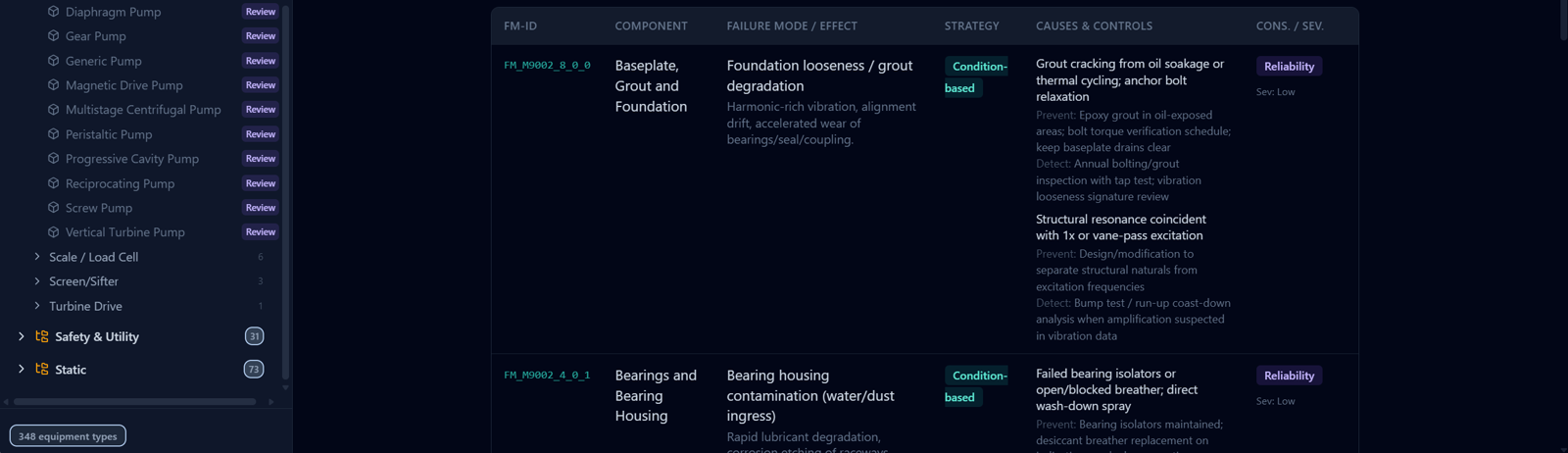
Reliability data — failure rate, MTBF, MTTR — is never estimated. It is populated from licensed reliability data sources or your own site failure history, and left blank until it is real.
A real job plan.
This is what a craftsman receives: one controlled format, with limits and acceptance criteria printed on the page.
- ·LOTO required to remove coupling guard
- ·Hearing protection, FR coverall, face shield
- ·Hot surface — housing may exceed 150 °F
- ·Confirm seal flush isolated before opening pot
- ·Vibration data collector, 2 accelerometers
- ·IR thermometer
- ·Torque wrench, 0–300 ft-lb
- ·Dial indicator set, feeler gauges
- ·Oil sample bottle, labeled
- ·Seal cartridge — CRITICAL spare
- ·Bearing set, drive + non-drive — CRITICAL
- ·Coupling element, elastomer
- ·VG 68 turbine oil, 1 qt
- ·Gasket kit, casing drain
Quantitative limits, not “check condition.” Any craft running this plan on this pump gets the same answer, and the result is a data point the program can learn from.
See it on your assets.
We will open the library against the equipment classes you actually run, and show you what would load into your CMMS.